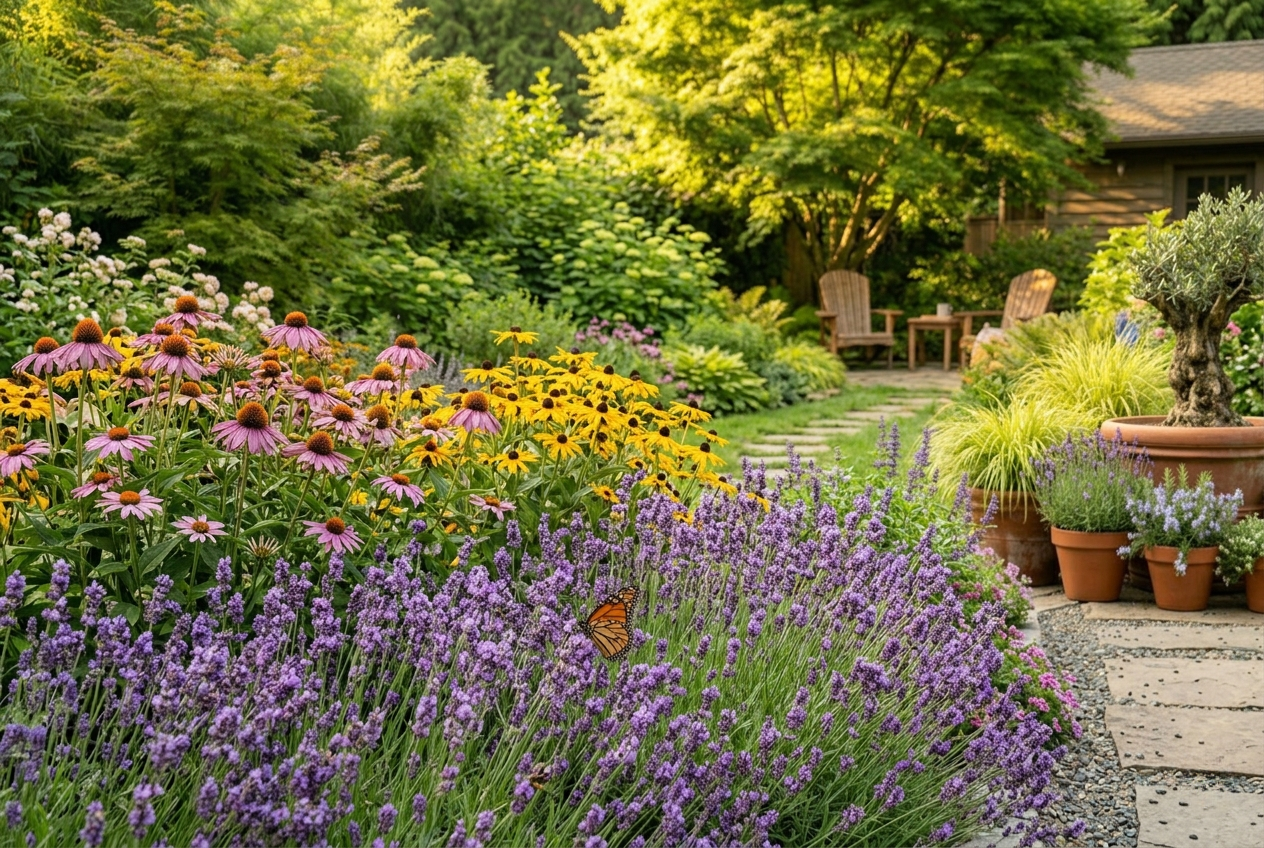
Discover 21 backyard garden design ideas that transform any outdoor space into a beautiful retreat — on any budget and any yard size.
Most people look at their backyard and see a problem to solve. A patch of grass that needs mowing. A corner that somehow always looks bare no matter what you put there. A space that’s technically outside but never feels like somewhere you actually want to spend time.
Here’s the thing nobody tells you: a beautiful backyard garden has almost nothing to do with the size of your yard or the size of your budget. It has everything to do with knowing which decisions actually matter — and which ones are just expensive distractions.
This guide covers 21 backyard garden design ideas that work in real yards, for real people who don’t have a landscaping team on speed dial. Whether you’re starting from a blank lawn or trying to breathe new life into a tired outdoor space, something in here will change how you see your backyard.
What You’ll Learn
- The one layout decision that makes small backyards feel twice as large
- How to create distinct zones in your garden without building anything permanent
- The cheapest high-impact upgrade you can make this weekend (it’s not what you think)
- Which 2026 garden trends are worth following — and which ones to ignore
- How to design a backyard garden that looks intentional, not accidental
1. Start With Zones, Not Plants
Most people make the same mistake when designing a backyard garden — they start choosing plants before they’ve decided what the space needs to do. The result is a yard that looks busy but doesn’t feel functional. You end up with flowers here, a random seating area there, and a patch of mulch in the corner that never quite made it into the plan.
The single most effective thing you can do before spending a dollar on your garden is divide your backyard into zones. A dining zone. A relaxing or lounging zone. A planting or growing zone. A pathway that connects them.
Each zone serves a purpose. Each one has a visual anchor — a table, a raised bed, a tree, a water feature — so the eye knows where to land when it moves across the space. Once you have zones, every other decision becomes easier because you’re filling a defined space rather than staring at an open lawn hoping for inspiration.
This is how professional garden designers approach every project regardless of budget or size. And it’s the one shift that separates backyards that look designed from backyards that look like they just happened.
Takeaway: Design your zones first. Plants come after.
2. Use Curved Paths To Make Small Yards Feel Larger
Straight lines are the enemy of a small backyard. A straight path from the door to the fence takes the eye directly to the boundary of the space — and all the eye sees is how small that distance is.
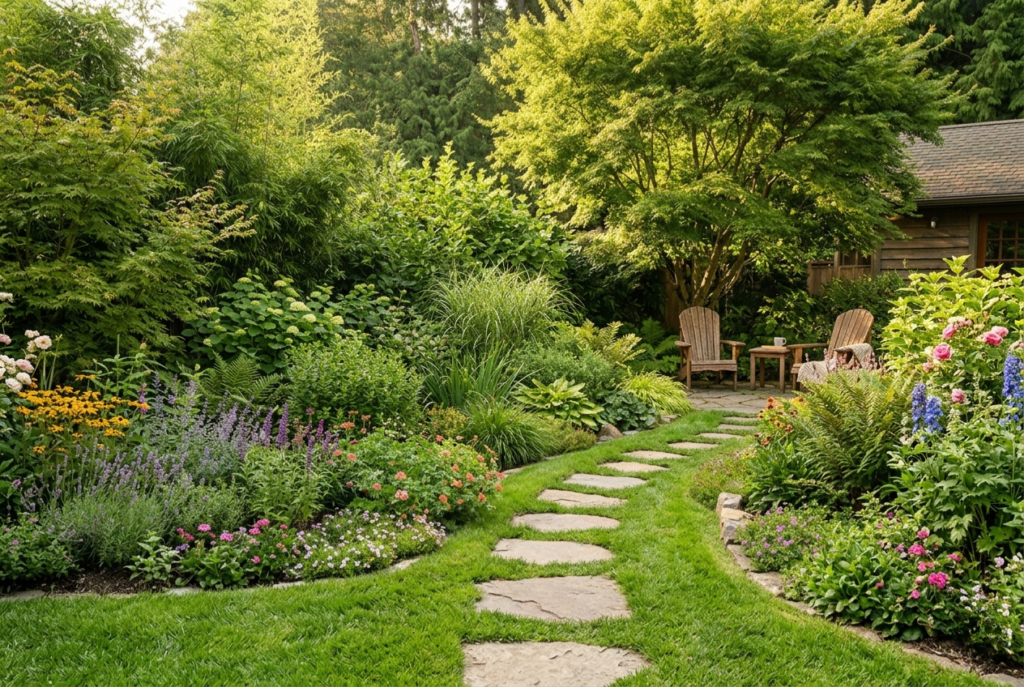
A curved path does something completely different. It slows the eye down. It suggests the garden continues around the bend even when it doesn’t. It creates mystery and movement in a space that might only be 20 feet deep on paper.
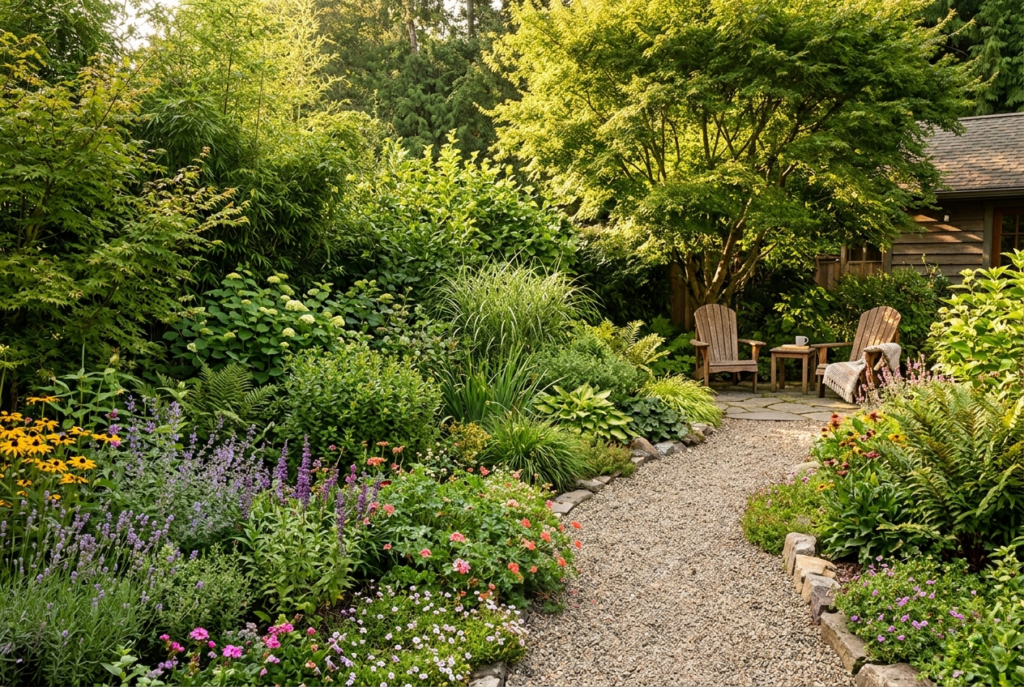
You don’t need pavers or professional installation to create a curved pathway. Gravel, wood chips, or even a line of stepping stones placed in a gentle curve through the lawn will do exactly the same job. Keep the curve generous and natural-looking — not a sharp angle, but a soft bend that feels like it belongs there.
This is one of the most impactful and least expensive changes you can make to a backyard garden layout, and it works in yards of every size.
Takeaway: Curves create the illusion of depth and make every yard feel bigger than it is.
3. Layer Your Planting Heights
A flat garden is a forgettable garden. When everything sits at the same height — low ground cover, medium shrubs, more medium shrubs — the overall effect is flat and static, like a carpet rather than a landscape.
Layered planting is what gives a garden visual depth and that “designed” quality that’s hard to put your finger on but immediately noticeable. The concept is straightforward: tall plants or structures at the back, medium plants in the middle, low ground cover or flowers at the front. This creates a sense of depth even in a small planting bed.
In practice, this might mean a tall ornamental grass or a climbing rose on a trellis at the back of a border. A few medium shrubs in front of that. Then a low border of lavender, creeping thyme, or small flowering perennials at the very front edge. Each layer is visible. Each one plays a different role. And the whole arrangement looks far more considered than three identical bushes in a row.
Takeaway: Three height levels in any planting bed instantly makes it look professionally designed.
4. Add A Focal Point That Draws The Eye
Every well-designed garden has at least one focal point — a single element that immediately catches your attention when you look at the space. Without one, the eye wanders aimlessly and the garden never quite settles.
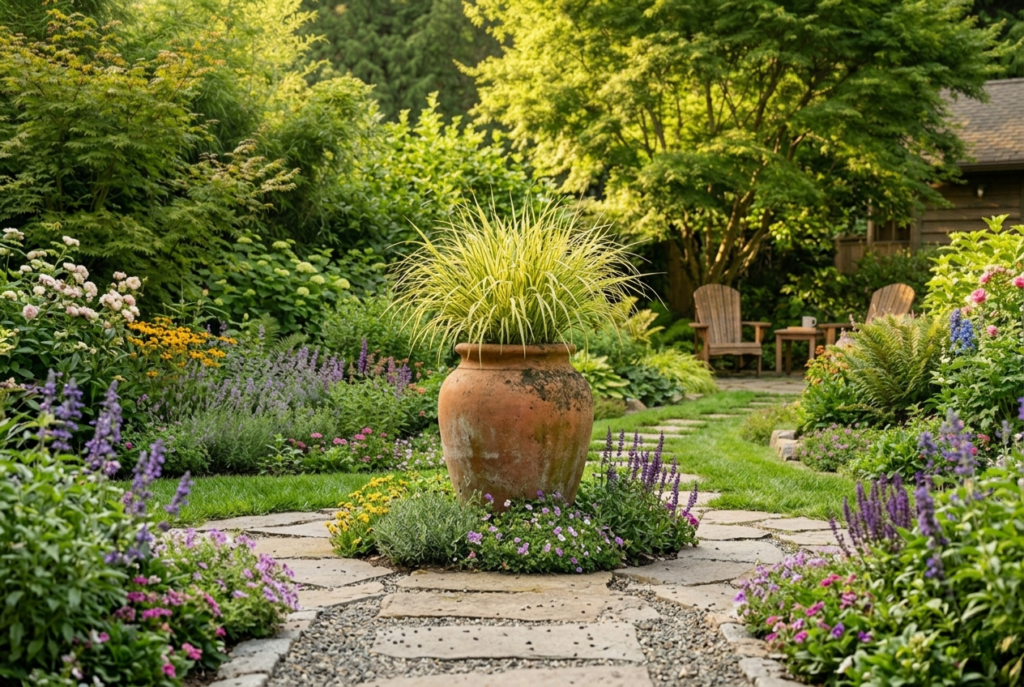
A focal point can be almost anything: a statement tree, a water feature, a large decorative pot, a garden bench, a pergola, or even a striking piece of garden art. What matters is that it’s visually distinct from everything around it and positioned where the eye naturally lands — usually at the end of a path, in the center of a border, or visible from the main outdoor seating area.
If you’re working with a limited budget, a single large ceramic pot planted with something architectural — a tall grass, a topiary, or a dramatic succulent — can serve as a focal point in a corner or at the end of a garden path for very little cost. The key is commitment: one bold choice rather than several timid ones.
Takeaway: One strong focal point does more for a garden’s appearance than ten mediocre additions.
5. Create A Cozy Outdoor Seating Area
A backyard that has nowhere comfortable to sit is a backyard you’ll never actually use. And yet a surprising number of people put serious effort into their planting and almost none into their seating — ending up with a beautiful garden they experience exclusively through the window.
A proper outdoor seating area doesn’t need to be expensive or elaborate. Two or three chairs around a small table, positioned on a flat surface (paving, decking, compacted gravel, or even a large outdoor rug on grass), and partially enclosed by planting on at least two sides to create a sense of shelter — that’s genuinely all it takes to create a space that invites you to sit down and stay.
For 2026, the trend is toward seating areas that feel like outdoor rooms rather than furniture parked on a lawn. Think about what makes an indoor room feel comfortable — a rug to define the space, lighting for evenings, something overhead (a pergola, a sail shade, even a large umbrella) to create enclosure. Bring those same elements outside and the difference is immediate.
Takeaway: A seating area that feels sheltered and defined will get used. One that just sits in the middle of the lawn won’t.
6. Try Container Gardening For Instant Flexibility
Container gardening has become one of the most popular garden design approaches in 2026, and for good reason. It solves problems that traditional in-ground gardening can’t — particularly for renters, people with poor soil, small outdoor spaces like balconies or patios, or anyone who wants the flexibility to change their garden layout without committing permanently.
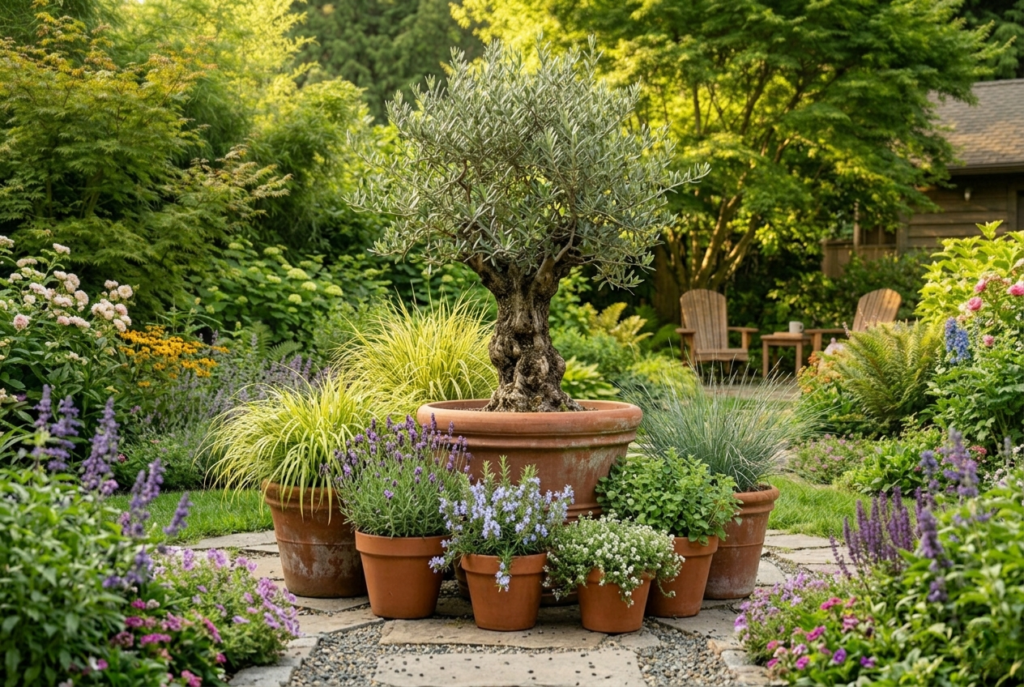
Large containers planted with a single statement plant — an olive tree, a tall ornamental grass, a bay tree clipped into a loft shape — can act as living architectural elements that define the structure of a space. Grouped clusters of smaller containers with different heights create the same layered effect as in-ground planting beds without any digging. And containers can be moved, rearranged, and replanted as seasons change.
For maximum visual impact, stick to a consistent container material across your space — all terracotta, all dark grey concrete, all whitewashed ceramic — rather than mixing every material available. Variety in plants, consistency in containers. That combination looks intentional and designed rather than accumulated over time.
Takeaway: Containers give you a designed garden without the permanent commitment — perfect for renters and small spaces.
7. Install Garden Lighting For Evening Use
Most backyard gardens are invisible after dark — which means they’re unusable for roughly half the hours of any given day. Garden lighting is one of the highest-impact upgrades available because it doesn’t just extend the usable hours of your outdoor space; it completely transforms how the garden looks in the evening, creating an atmosphere that’s impossible during daylight.
Solar stake lights along a pathway are the obvious starting point and they’re inexpensive and easy to install. But the more interesting lighting choices are the ones that create atmosphere: uplights at the base of trees or statement plants that cast dramatic shadows upward; string lights hung overhead across a seating area; a small lantern or hurricane lamp on an outdoor dining table. These are the details that make an evening in the garden feel genuinely special.
For 2026, smart garden lighting that adjusts automatically with timers or responds to motion sensors is increasingly accessible and affordable. But even the simplest solar-powered stake lights along a curved garden path look magical after dark and cost very little to install.
Takeaway: Lighting turns your garden into an evening destination rather than just a daytime view.
8. Grow Edible Plants Alongside Decorative Ones
One of the strongest garden design trends heading through 2026 is the blending of edible and ornamental plants in the same beds — what designers are calling “potager-style” or kitchen garden planting. The era of keeping the vegetable patch hidden at the bottom of the garden in an embarrassed corner is over.
Herbs like rosemary, lavender, and bronze fennel are as beautiful as most ornamental plants and far more useful. Rainbow chard has striking colored stems that look genuinely decorative in a mixed border. Climbing beans and cucumbers add vertical interest to structures that would otherwise just be empty trellises. Fruit trees in containers become statement pieces on a patio while producing actual fruit.
Beyond the practical appeal, there’s something deeply satisfying about spending time in a garden that feeds you as well as looks beautiful. It changes how you relate to the space — you’re out there more often, paying more attention, and feeling more connected to what you’ve grown.
Takeaway: Edible plants mixed with ornamentals give you a garden that’s beautiful and useful at the same time.
9. Use Raised Garden Beds To Add Structure
Raised garden beds are one of those design elements that simultaneously solve a practical problem and make a garden look more intentional. Practically, they improve drainage, warm up faster in spring, keep weeds more manageable, and make gardening easier on the back. Aesthetically, they add clean geometric structure to a garden that might otherwise feel unorganized.
Even a single raised bed, well-placed and well-planted, can become a defining element of a backyard garden design. Two or three identical beds arranged symmetrically create a classic kitchen garden feel. A long narrow raised bed along a fence line turns an underused boundary into an active, productive garden element.
For materials, cedar is the traditional choice because it’s naturally rot-resistant. But corten steel raised beds have become increasingly popular for their warm weathered appearance and near-permanent durability. Concrete block beds are the cheapest option and look cleaner than you’d expect when painted in a consistent color.
Takeaway: Raised beds bring structure, function, and a polished look to any backyard garden.
10. Add A Water Feature — Even A Small One
The sound of moving water does something to outdoor spaces that no other design element replicates. It creates a sense of calm and masks background noise from neighbors, traffic, or other urban sounds. Even a small self-contained water feature — a bubbling stone, a small bowl fountain, a modest wall-mounted spout — adds a dimension to a backyard garden that’s immediately noticeable.
Self-contained water features that recirculate their own water are widely available, require no plumbing connection, and can be installed in an afternoon. Solar-powered versions are particularly practical since they run for free and don’t require an outdoor electrical outlet. Positioned near a seating area where you’ll actually hear the sound, a small water feature elevates the sensory experience of a garden in a way that even expensive planting rarely achieves.
Takeaway: Moving water is the most underrated sensory upgrade available to any backyard garden.
11. Create Privacy Without Building A Fence
Tall fences can feel oppressive in a small garden and planning restrictions sometimes limit your options anyway. But there are several ways to create genuine privacy in a backyard garden that feel more natural, more beautiful, and often more effective than a panel fence.
Tall ornamental grasses planted in a row create a soft, moving privacy screen that shifts with the breeze and looks beautiful year-round. Bamboo in containers (running bamboo should always be contained to prevent spreading) grows quickly and creates excellent screening. Climbing plants on a simple trellis or wire framework can reach significant heights within a season or two and provide year-round green cover once established.
The most effective approach combines two or three of these elements at slightly different heights, creating a living boundary that feels like part of the garden design rather than a barrier bolted around its edges.
Takeaway: Living privacy screens look better, feel better, and often work better than fences.
12. Design For Year-Round Interest
A garden that’s spectacular in summer and depressing the other nine months of the year is a missed opportunity. Designing for year-round interest is a more sophisticated approach, and it doesn’t require significantly more plants — just more deliberate plant selection.
The framework is simple: make sure every corner of your garden has something visually interesting in at least three of the four seasons. Evergreen structure (box, yew, or ornamental grasses) provides the winter backbone. Spring bulbs pushed through ground cover provide early color. Summer flowering perennials fill the middle months. And seed heads, berries, autumn color, and late-flowering plants like rudbeckia and sedums carry you through to winter.
The easiest way to start building year-round interest into an existing garden is to identify which months feel most bare and specifically add plants that perform during those periods. One or two well-chosen additions per “dead” season is all it takes to transform a garden that has one good moment into one that always has something worth noticing.
Takeaway: A truly well-designed garden looks good in every season, not just summer.
13. Choose A Consistent Color Palette
Wild, mixed-color planting borders have their place, but for homeowners who want their garden to look deliberately designed rather than accidentally assembled, choosing a consistent color palette for your planting makes an enormous difference.
The simplest approach is a two-color combination — say, purple and yellow, or white and green, or pink and silver. Plants selected within this palette, even a large number of different species, will create a cohesive overall impression. Add a third color as an accent used sparingly and the combination gains depth without becoming chaotic.
For 2026, the strongest garden color trends are moving toward warm, earthy tones that feel connected to the natural landscape: terracotta, amber, warm red, deep burgundy, and rich cream. These work beautifully against the green of foliage and feel current without being so trend-dependent that they’ll look dated in three years.
Takeaway: A two-color planting palette always looks more designed than a garden that uses every color available.
14. Use Mulch As A Design Tool, Not Just A Practical One
Most people think of mulch as something you spread around plants to suppress weeds and retain moisture — a practical necessity rather than a design choice. But mulch, chosen well and applied generously, is one of the most visually effective finishing touches in any garden.
Dark bark mulch around planting beds makes the plants themselves pop forward visually, provides a clean defined edge between planted and unplanted areas, and gives the whole garden a tidy, finished look that’s hard to achieve any other way. Pale gravel mulch creates a more contemporary, minimalist feel and works beautifully in hot dry gardens or with architectural planting styles.
The key is using enough of it — a thin, patchy layer of mulch looks worse than no mulch at all. A generous 3-inch layer applied right up to the base of plants (but not touching stems directly) looks intentional and professional while doing all the practical work mulch is meant to do.
Takeaway: Good mulch makes every garden look more expensive and better maintained than it actually is.
15. Build A Simple Pergola Or Garden Structure
A garden with no vertical structure often feels incomplete, like a room with no walls. A pergola, an arbor, a simple wooden arch, or even a bamboo teepee structure gives the garden a sense of enclosure and scale that planting alone struggles to provide.
Pergolas don’t have to be elaborate or expensive to be effective. A simple four-post structure with a slatted roof, positioned over a seating area, changes the feel of that space from “chairs sitting on a lawn” to “an outdoor room.” Draped with a climbing rose, a wisteria, or a jasmine that flowers in summer, it becomes something genuinely beautiful. Even without planting, the structure itself casts dappled shadow and creates architectural interest.
Flat-pack pergola kits are widely available and can be installed in a weekend without professional help. For a more minimal look, a sail shade stretched between posts or from a wall achieves a similar sense of overhead enclosure for even less.
Takeaway: Vertical structure transforms an outdoor space from a garden you look at to a garden you live in.
16. Plant For Pollinators
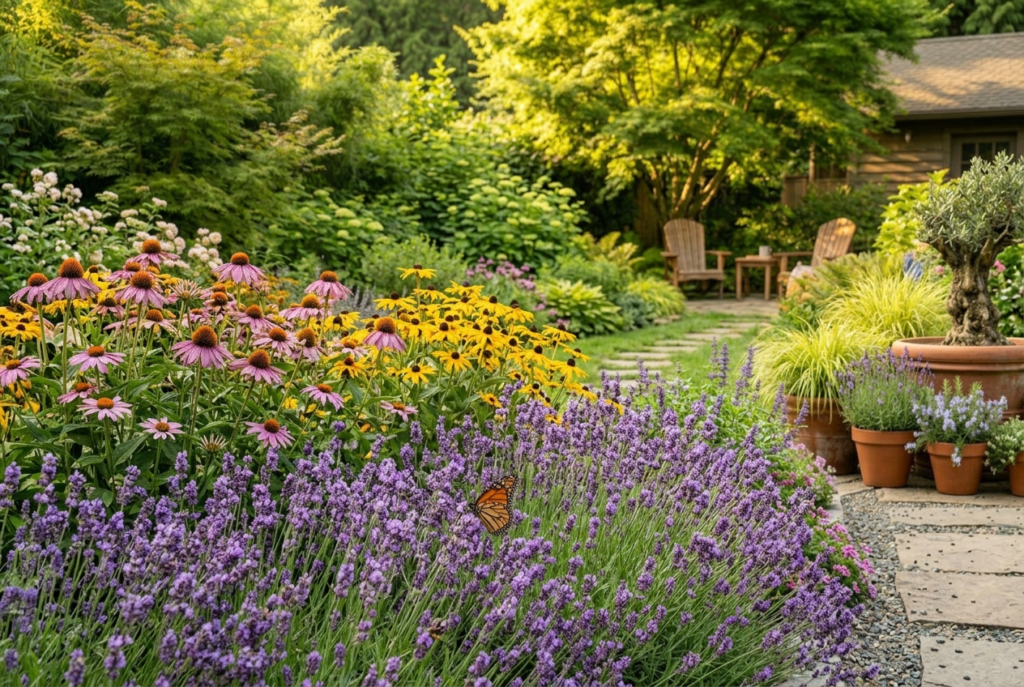
This might sound purely ecological but it’s also one of the most practical design decisions you can make. Gardens planted with pollinator-friendly plants — lavender, echinacea, alliums, salvias, foxgloves, sedums — tend to look more alive, more dynamic, and more beautiful than gardens planted without them, because they literally are more alive.
Bees, butterflies, hoverflies, and other pollinators are in the garden constantly when the right plants are present. That constant movement adds a dimension to a garden that no amount of careful planting arrangement replicates. And most pollinator-friendly plants happen to be among the easiest, most low-maintenance choices available — they’re adapted to manage on their own with minimal intervention.
For a starter pollinator planting, lavender is impossible to beat. It flowers for months, smells incredible, requires almost no care, tolerates drought, and attracts every type of pollinator imaginable. A generous sweep of lavender along a sunny border edge is one of the most effective and affordable upgrades available to any garden.
Takeaway: A garden that supports pollinators is more beautiful and more alive — not just more ethical.
17. Add An Outdoor Dining Area
An outdoor dining area is one of the most used and most appreciated garden additions for families and individuals alike — yet it’s one of the last things many people think to include in their garden design. The difference between eating inside and eating at a well-designed outdoor table in a garden on a warm evening is significant enough to change how you feel about both your garden and your home.
The essentials are modest: a table and chairs appropriate for the number of people you typically host, positioned on a stable flat surface, with some form of shelter from direct sun (a parasol, a pergola, or a sail shade) and outdoor lighting for evenings. The surrounding planting should feel close enough to make the space feel connected to the garden, but not so dense that it feels crowded.
For small gardens, a fold-flat table that stores against a wall and can be set up when needed avoids the permanent footprint of a fixed dining set while still providing the option when you want it.
Takeaway: An outdoor dining area is the garden addition that gets used the most and regretted the least.
18. Let Some Areas Go Wild On Purpose
This might be the most counterintuitive advice in this article but it’s also one of the most valuable. Not every corner of your backyard garden needs to be tidy, managed, and under control. Deliberately leaving a small area to grow in a more naturalistic way — long grass allowed to seed, a patch of wildflowers, a pile of logs for wildlife — adds a layer of texture and authenticity to a garden that manicured planting alone never quite achieves.
The trick is that the wild area needs to look intentional. A neatly mown edge around a wildflower meadow patch tells the eye that this is a deliberate design choice, not neglect. A small sign or marker does the same job. Without that clear intentionality, a wild area just looks like a corner you forgot to maintain.
This approach is also the lowest-maintenance option available for difficult corners — steep slopes, areas with poor soil, parts of the garden that are too shaded for most ornamental planting. Let nature take a degree of control and the results are often more interesting and more honest than anything you’d have planted there yourself.
Takeaway: A deliberately wild area makes the rest of your garden look more designed by contrast.
19. Use Repetition To Create Visual Rhythm
One of the hallmarks of a professionally designed garden — and one of the easiest professional tricks to borrow — is repetition. Using the same plant, pot, or design element at regular intervals through a garden creates a visual rhythm that ties the whole space together and makes it feel coherent rather than randomly assembled.
This doesn’t mean everything has to match. It means choosing one or two elements to repeat and trusting that repetition to do its connecting work. The same ornamental grass repeated at each corner of a border. The same terracotta pot used three times along a path. The same low hedge used as the edging material throughout the garden. These repeated elements create continuity that the eye reads as intention, and intention reads as design quality.
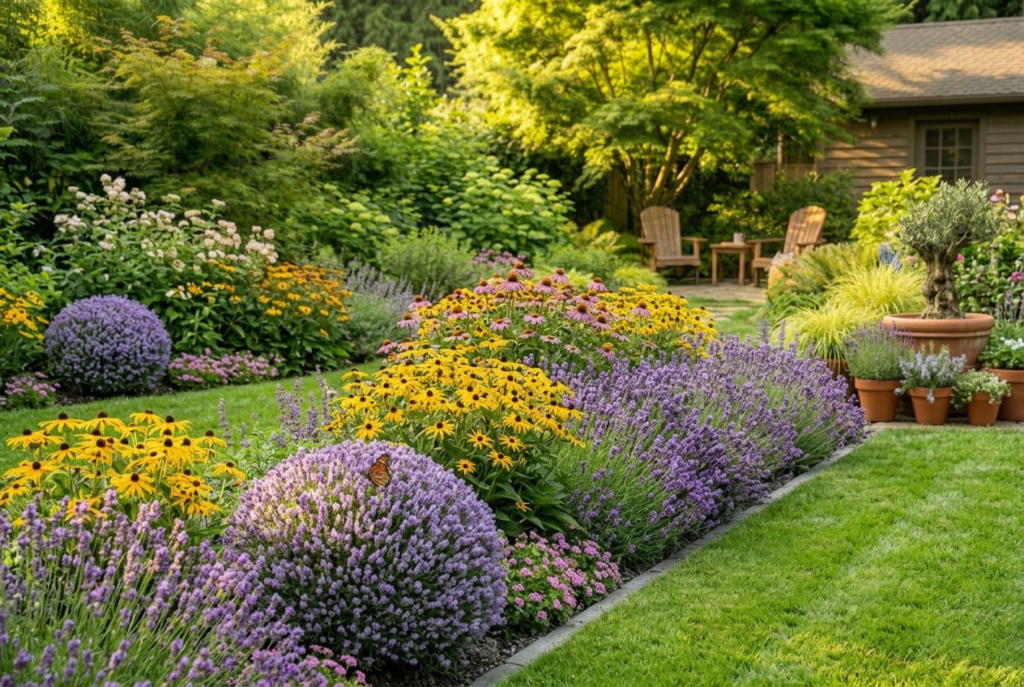
The most common version of this is the repeated use of a single plant species to create a rhythm through a border — lavender balls at regular intervals, for example, or a repeated accent of red hot pokers through a mixed planting. Simple, inexpensive, and immediately effective.
Takeaway: Repetition of a single element is the quickest way to make any garden look deliberately designed.
20. Install A Simple Irrigation System
This one is practical rather than aesthetic, but it belongs in any honest guide to backyard garden design because it determines whether the beautiful garden you create actually survives. Gardens that rely entirely on hand watering get neglected during busy weeks, which means plants die, which means the whole design falls apart.
A basic drip irrigation system connected to a simple timer costs very little, can be installed without professional help, and automates the single most time-consuming element of garden maintenance. Set it up once and your plants are watered consistently whether you’re home or not.
For container gardens especially, automated irrigation is transformative. Containers dry out far faster than in-ground planting and missing even a day or two of watering in hot weather can kill plants that took months to establish. A simple drip line connected to a timer takes that vulnerability completely off the table.
Takeaway: Automated irrigation keeps your garden alive during the weeks when life gets busy — which is every week.
21. Photograph Your Garden At Golden Hour
This final point is not about garden design in the traditional sense, but it matters more than most people realize. If you’re using Pinterest, Instagram, or any other platform for inspiration or sharing, the photographs you take of your garden shape how you see and feel about it — and what you decide to do with it next.
Gardens photographed at golden hour (the first hour after sunrise or the hour before sunset) look dramatically more beautiful than the same garden photographed in harsh midday sun. The warm, low-angled light makes every color richer, every texture more pronounced, and every corner more inviting. It’s the same garden. It’s the same planting. But it looks completely different.
Making a habit of photographing your garden at golden hour not only gives you better images to share — it gives you a more accurate and generous view of what you’ve actually created. And that perspective keeps you motivated to keep building and improving the space.
Takeaway: The right light doesn’t just photograph a garden beautifully — it helps you see it properly for the first time.
Expert Perspective — The One Thing That Changes Everything
Here’s a contrarian take that most garden design advice misses entirely.
The biggest difference between a backyard that looks designed and one that doesn’t isn’t the plants, the budget, or the size of the space. It’s editing.
The gardens that look most beautiful are almost always the result of removing things, not adding them. A bench in the wrong place. A plant that doesn’t fit the palette. Three different types of paving materials that each seemed like a good idea at the time. A feature that made sense five years ago but no longer belongs.
Restraint is the hardest skill in garden design — and the most valuable. Every time you’re tempted to add something new, ask whether removing something existing might make a bigger difference. Often it does.
The best garden designers spend as much time deciding what not to include as they do choosing what to plant. That discipline is what separates gardens that look curated from gardens that just keep accumulating.
Frequently Asked Questions
Q: What is the easiest backyard garden design idea for beginners? Start with raised garden beds and container planting. Both are forgiving, flexible, and produce visible results quickly. You don’t need to commit to a permanent design, and you can move things around as you learn what works in your specific space and conditions.
Q: How do I design a backyard garden on a small budget? Focus on the structural decisions first — zones, pathways, a focal point — because these are often low or zero cost and have the biggest visual impact. Then add plants slowly, starting with a few key performers rather than filling the whole space at once. Mulch generously to make modest planting look established.
Q: What are the best low-maintenance backyard garden plants? Lavender, ornamental grasses, sedums, rudbeckia, echinacea, salvias, and most native perennials are all excellent low-maintenance choices. They’re adapted to manage in typical garden conditions with minimal watering, feeding, or intervention once established.
Q: How do I make a small backyard look bigger? Use curved pathways instead of straight lines. Plant tall at the back and low at the front. Add a mirror or reflective surface on a fence. Choose a consistent color palette so the eye isn’t pulled in multiple directions. And avoid cluttering the space with too many small items — a few larger elements always make a space feel bigger than many small ones.
Q: How do I create privacy in my backyard garden without a fence? Tall ornamental grasses, bamboo in containers, climbing plants on trellises, and dense evergreen shrubs all provide excellent screening without the visual weight of a solid fence. Combining two or three of these at different heights creates layered privacy that looks like intentional planting rather than a barrier.
Conclusion
A beautiful backyard garden isn’t built in a weekend and it isn’t bought with a large budget. It’s built through a series of considered decisions — about zones, structure, planting layers, and the deliberate restraint to not add everything at once.
Start with one idea from this list. Not twenty-one. One. Get it right, see how it changes the space, and let that momentum carry you to the next decision.
The backyard garden you want already exists. You just haven’t finished editing it yet.